

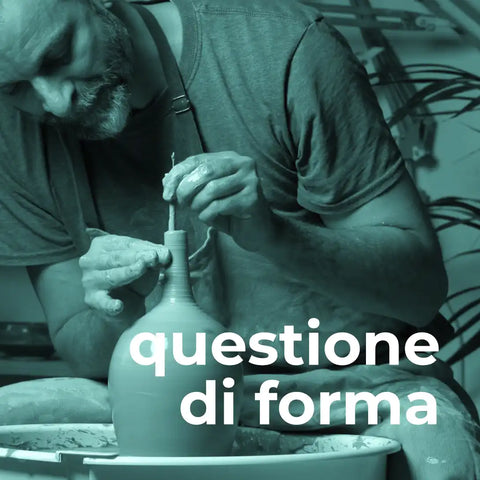
A matter of form - Intermediate wheel-throwing course
Price:
€210.00
Friday, October 16, from 7:00 PM to 10:00 PM
A good bottle doesn’t start with the neck. It starts with proportion.
In this intermediate/advanced course, structured over 3 three-hour sessions, we will explore the making of bottles, tall vessels and narrow-necked forms, approaching them not simply as technical exercises on the wheel, but as small design projects.
We will work on closing a form and shaping a controlled neck, but above all we will learn to understand how belly, shoulder, neck and opening relate to one another, and how even a small change in proportion can completely transform the character of a piece.
We will look at silhouette, balance and the rhythm of a form. We will consider where to place a handle, how large it should be and how to make it feel like an integral part of the object rather than something added afterwards.
We will also focus on functionality: sizing an opening correctly for a stopper, allowing for clay shrinkage, designing fitted parts and closures, and experimenting with more complex solutions such as threaded elements.
Before the course begins, you will receive an inspiration moodboard featuring bottles, vessels and forms from the worlds of ceramics and design. It will be a starting point for observing, collecting references and arriving at the first class with your own ideas and direction.
The aim is not to reproduce a specific shape, but to learn how to read it, modify it and design it with intention.
October 16 – Form, proportion and throwing
We will begin by looking at silhouettes and proportions to understand what makes a tall form feel balanced, tense, elegant or deliberately off-centre. At the wheel, we will work on the belly, shoulder, closing the form and shaping the neck, experimenting with different proportions starting from similar volumes of clay.
October 23 – Neck, details and function
We will trim the pieces at leather-hard stage and focus on the elements that turn a form into an object: openings, rims, handles, stoppers and possible closure systems. We will consider ergonomics, clay shrinkage, tolerances and the relationship between function and visual balance.
October 30 – Surface and the final reading of the form
After the bisque firing, we will approach glazing as part of the design process. Colour, texture, matte or glossy surfaces and carefully chosen glaze breaks can emphasise a shoulder, visually lengthen a neck or completely change the way a form is perceived.
A course for anyone already familiar with the wheel who wants to take their practice further: not simply to gain more control over the clay, but to make more deliberate decisions about form.
Because the difference between a well-thrown vessel and a truly successful one can sometimes come down to just a few centimetres.