

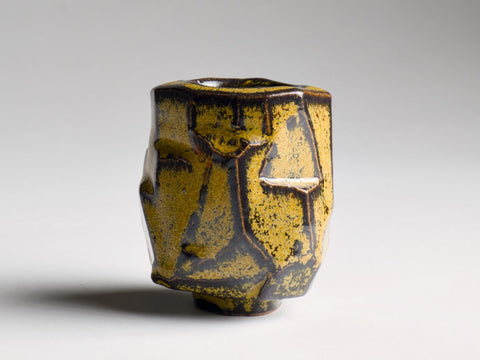
Last Saturday I was at the Milan Ceramics Festival. As always, beyond the objects on display, what interests me most is watching the people. When someone picks up a handmade cup, the first reaction is almost always the same: "You can feel it's different."
I hear that phrase often in my studio too. Sometimes it comes from people who have never worked with clay, other times from students who are beginning to understand how much a seemingly simple object can contain: the way it was formed, the drying time, the choice of clay, the hand that shaped it, the firing temperature, the glaze, even the mistakes corrected along the way.
A ceramic object isn't just something you look at. It's something you read.
Surface, form, and weight aren't separate aesthetic qualities. They're clues. They tell the story of how a piece was born, what decisions were made, what relationship exists between function and material. In this article I want to try to explain how, not to judge rigidly, but to understand more deeply.
Handmade ceramics aren't simply "irregular"
One of the most common misconceptions is that a handmade object can be recognised because it's crooked or asymmetrical. It's not that simple.
A hand-built piece can be extremely precise. A well-thrown bowl can have thin walls, a clean curve, a carefully trimmed foot. Conversely, an irregular object isn't automatically a well-made one. Irregularity alone isn't enough.
What matters is the quality of the relationship between the parts: rim, foot, internal volume, wall thickness, surface, the way an object rests on a table and the way it meets the hand. Handmade ceramics aren't recognisable because they're "not perfect." They're recognisable because they carry a material logic, and every choice, even a rough surface or a slightly variable wall, should make sense in relation to the presence of the object and its use.
Surface: the skin of an object
Surface is the first thing we see, but often the thing we understand least.
In ceramics, surface isn't just colour. It's the point where ceramic body, glaze, fire, and time meet. A glossy, uniform glaze communicates a certain idea of precision. A satin glaze absorbs light more softly. A matte surface makes an object quieter, more material. A microcrystalline surface holds the eye because it shifts constantly with the light.
In my own work I'm drawn to what I think of as live surfaces: glazes that don't simply sit on top, but seem to belong to the body of the object. Surfaces where fire has played a visible role, not a decorative one.
When you look at a piece, ask yourself whether the surface feels flat or deep, whether the glaze covers the form or converses with it, whether the colour shifts in areas of accumulation, along the rim, near the foot. An interesting glaze is rarely identical at every point. It thickens in recesses, thins over edges, reveals the clay body in places, creates depth.
A word of caution: not every variation is a virtue. Excessive drips, adhesion defects, bubbles, sharp areas, or surfaces unsuitable for food contact are real problems. The difference lies in control. A skilled ceramist doesn't necessarily eliminate every variation. They learn to govern it.
Form: balance, tension, and function
Form is the way an object occupies space.
A cup isn't just a cylinder with a handle. It's a system of relationships: diameter, height, wall curve, rim thickness, foot proportion, handle width, internal capacity, stability. When a form works, we often don't notice immediately. We simply use it. The hand finds its place, the rim meets the mouth without resistance, the weight doesn't pull at the wrist. When something doesn't work, the body registers it before the eye does.
Reading form means observing the transitions between parts. Where does the curve begin? Is the volume taut or slack? Does the rim actually conclude the form, or does it just cut it off? Does the foot support the object or look like an afterthought? Does the handle belong to the body, or is it simply attached?
On the wheel, this reading becomes even clearer. A well-thrown form often carries an internal continuity. Even when it's simple, it has rhythm. It isn't a question of perfect symmetry. It's a question of intention.
Weight: the most underrated quality
Weight is one of the most important and least discussed aspects of ceramics.
When you pick up an object, its weight tells you something immediately: how much material was left in the base, how thick the walls are, how much the piece was refined and lightened, how much thought went into its use. A cup that's too heavy can feel solid but become tiring. A cup that's too light can feel elegant but fragile. The right weight isn't an absolute number. It depends on function.
In my studio I often come back to this point: removing clay doesn't simply mean making a piece lighter. It means clarifying the form. Trimming at leather-hard isn't a secondary stage. It's the moment when a piece is re-read, corrected, brought closer to its final shape.
Rim and foot: the details that don't forgive
The rim is perhaps the most revealing part of a ceramic object. On a cup it's the point of contact with the mouth. A rim that's too thick makes drinking unpleasant, one that's too thin chips easily, one left without intention makes the entire form feel unresolved. When I look at a student's work, the rim is usually where I look first. It doesn't have to be perfect, but it has to be resolved. It's a small detail that contains the entire discipline of the piece.
The foot, by contrast, is the part that gets looked at least, and says the most. Turning an object over and examining the base is a simple, almost instinctive gesture. That's where you understand how much care went into the piece after the initial forming. A well-made foot provides balance, avoids unnecessary accumulation of material, and gives the object stability. In handmade ceramics, the foot is often a quiet signature. Not because a name is written there, but because it reveals how the maker finishes their work when the viewer's attention has already moved on.
The trace of the hand: when it's value and when it isn't
Many people look for the trace of the hand in handmade ceramics. It's understandable. In a world full of perfectly replicable industrial objects, the human mark becomes precious. But it's worth being careful.
Not every trace is interesting. Some are simply distractions, others arise from inexperience, others still become language. The difference lies in coherence. A deliberately rough surface needs a relationship with the form. A mark left by the fingers should feel necessary, not accidental. The hand shouldn't become an excuse.
In ceramics, authenticity doesn't mean disorder. It means a recognisable presence of process.
How to distinguish a handmade piece from an industrial one
It isn't always easy, especially today. Many commercial productions imitate irregular surfaces, reactive glazes, undulating rims, natural colours. The aesthetic of imperfection has become a widely spoken language.
An industrial object repeats irregularity serially: the surface may appear variable, but within a predictable grammar. Forms are identical, weights very similar, bases standardised, marks distributed like a pattern.
A handmade object carries deeper variation, not just decorative but structural. The weight shifts slightly from piece to piece. The foot shows specific trimming decisions. The glaze responds differently across the surface. The form retains micro-decisions made during the process. Industry seeks repeatability. Craft seeks continuity within variation.
Ceramics is read with the hand too
There's a limit to looking: it stays on the outside.
Ceramics also asks to be held. A cup can look beautiful in a photograph and then feel awkward in use. A bowl can appear simple and then reveal a perfect balance of weight and volume. The hand understands things the eye only rationalises afterward: whether a rim is pleasant, whether weight is well distributed, whether a texture is welcoming or aggressive, whether an object invites use or keeps you at a distance.
This is why functional ceramics is so demanding. It has to pass the test of the body. Being photogenic isn't enough. It has to live in the gesture.
Looking at an object means looking at its process
Every ceramic object is the result of a sequence: clay preparation, forming, drying, trimming, bisque firing, glazing, glaze firing, cooling. In each of these stages, something can happen. A wall can warp, a glaze can react unexpectedly, a rim can lose its tension.
Reading a ceramic object means recognising that the finished piece isn't just "the result." It's the visible memory of a process. This is why a handmade object can have a quality that's hard to put into words. It doesn't simply appear manufactured. It appears transformed.
A practical guide to looking
If you want to start reading handmade ceramics more closely, begin with six questions.
What is the surface like? Does the glaze feel flat or deep, does it follow the form, create depth, without compromising function?
What is the rim like? Is it resolved, coherent with the object's purpose, pleasant to the touch?
How does the weight feel? Is it stable, well distributed, appropriate to how the object is meant to be used?
Is the foot carefully made? Turn the piece over. The base says a great deal.
Does the form have intention? It doesn't need to be perfect, but it should feel considered.
Does the object invite use? This may be the most important question of all: a functional ceramic piece should want to be used.
Learning to see more clearly
Recognising a handmade ceramic object doesn't mean building a rigid checklist of flaws and virtues. It means training the eye.
Surface, form, and weight aren't separate qualities. They're parts of the same conversation. Surface speaks of fire. Form speaks of gesture. Weight speaks of the relationship between material and function. When a piece works, these three things don't compete. They hold together.
That's where ceramics becomes genuinely interesting: when it doesn't simply aim to be beautiful, but keeps speaking while you use it.
A cup, a bowl, a plate can seem like simple objects. But if you learn to read them, you discover there's much more inside: technique, time, material, mistake, correction, choice. A well-made ceramic piece doesn't just ask to be looked at.
It asks for attention.
Erik
Erra Ceramica, Milan
Sources: F. & J. Hamer, The Potter's Dictionary of Materials and Techniques. D. Rhodes, Clay and Glazes for the Potter. M. Cardew, Pioneer Pottery.